

Historie
Malerisch auf einem Felsplateau hoch über der Saale gelegen, beeindruckt die einstige Burg der Vögte und Herren von Gera und Plauen und spätere Reußische Residenz Schloß Burgk mit historischen Repräsentations- und Wohnräumen und einem gewachsenen Bestand an historischem Interieur.
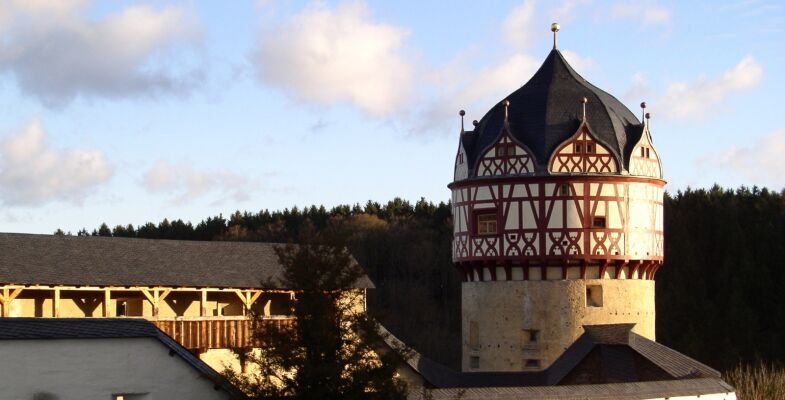
Schloß Burgk ist eine der wenigen erhaltenen spätmittelalterlichen Burgen Thüringens und der einzige vollständige Neubau dieser Zeit. Trotz Umgestaltungen verlor die Anlage in der Gebäudekonfiguration nie ihren spätmittelalterlichen Charakter. So umschließen noch heute beeindruckende Wehranlagen aus dem 16. Jahrhundert ein Gebäude, das hinter seiner schlichten, nahezu schmucklosen Fassade zahlreiche Kostbarkeiten birgt.
Das älteste erhaltene Dokument, eine Verpfändung der Burg(k) an den Deutschen Orden, datiert in das Jahr 1365. Die zweite glaubwürdige Nachricht berichtet über den Abbruch eines alten Schlosses 1403 und einen Neubau im selben Jahr unter Heinrich VII., Herr von Gera (1341- urk. bis 1420). Die „Dreiflügelanlage“ bildet bis heute den Kern des Schlosskomplexes.
1513 nahm Heinrich XV., der Jüngere (urk. 1496 -1550) seinen Wohnsitz auf der Burgk und veranlasste umfangreiche Innenausbauten, bei denen der wohnliche und repräsentative Ausbau der Burg im Vordergrund standen. Erst 1544/45 erhielt Burgk aufgrund sich anbahnender militärischer Konflikte mit Zwingerbefestigung und Rotem Turm seinen wehrhaften Charakter.
Im Schmalkaldischen Krieg fällt Burgk an die Burggrafen von Meißen. 1596 geht die Anlage in Besitz der älteren Linie Reuß (ä.L.) über und verbleibt in deren Eigentum bis zum Ende des Zweiten Weltkrieges.
Heinrich II. Reuß ä. L. (1575-1639) begründet 1616 die erste selbständige Herrschaft Burgk. Unter ihm erfolgt der Ausbau zum Residenzschloss. Der Küchenbau mit dem imposanten 21,5 m hohen Kamin wird errichtet, der Rittersaal erhält seine hölzerne, mit vegetabilen Motiven und Rollwerkkartuschen bemalte Decke, die mittels eines Hängesprengwerks die gesamte Grundfläche des Raumes stützenfrei überspannt. 1624/25 wird die Schlosskapelle erweitert. Das Schnitzwerk der überaus prächtigen Kanzel stammt aus der Hand des Schleizer Bilderschnitzers Hans Balbierer, von Paul Keil die fünf in die Empore eingelassenen Tafelbilder. Ebenfalls Hans Balbierer wird das „Burgker Bornkinnel" zugeschrieben. Der in kostbare Kleider gehüllte Christusknabe wurde in der Weihnachtszeit auf den Altar gestellt - eine im Vogtland bis ins 18. Jahrhundert gelebte Tradition.
1668 wird unter Heinrich II. Reuß ä. L. (1634-1697) das Zweite Haus Burgk begründet. Sichtlich stolz zeigt ihn ein großformatiges Gemälde im Rittersaal, das vermutlich 1673 anlässlich der Erhebung in den Reichsgrafenstand in Auftrag gegeben wurde.
Mit dem Tod Heinrich II. und der Zentralisierung der Reußischen Herrschaft in Greiz diente Burgk seit 1697 als Jagd- und Sommerschloss. Die Räume erfuhren stets modische Anpassungen und weisen daher eine vielgestaltige Baugeschichte auf.
So brachte von 1733 bis 1768 die Regentschaft Heinrichs III. Reuß-Untergreiz (1701-1768) eine künstlerische Blüte für Schloß Burgk. Bergfried und Torhaus wurden abgebrochen, die Nordostecke neu errichtet, Fenster vergrößert und vereinheitlicht. Vermutlich erfolgte in dieser Zeit auch die Anlage des großzügigen Treppenhauses. Weiter wurden die Innenräume in barocker Manier ausgestaltet. Der Kleine Saal erhielt seine monumentalen Wandgemälde mit Szenen aus Vergils Äneis, der Damensalon und die ‚Weißen Zimmer‘ bemalte Leinwand- oder kostbare Seidentapeten sowie Tapisserien aus der Berliner Manufaktur Charles Vigne. Alle Räume der bel étage wurden mit Kristalllüstern ausgestattet. Den eleganten Stuckdekor fertigte Johann Georg Schmidt (Lebensdaten unbekannt).
1742 wurde mit Gottfried Silbermann der seinerzeit berühmteste Orgelbauer Mitteldeutschlands verpflichtet, in der Schloßkapelle eine Orgel zu bauen. In Konzerten kann die Klangschönheit des 1743 geweihten Instruments, das bis heute in der originalen Chortonlage erklingt, genossen werden. Die Orgel zählt zu den wertvollsten Instrumenten Mitteldeutschland und ist ein Kulturdenkmal von nationalem Rang.
Wenige hundert Meter von der Burganlage entfernt liegt auf dem ehemaligen Schlingenberg der Sophienpark. Größer könnte der Kontrast nicht sein als zwischen dem 1751-1753 im Park errichteten lichtdurchfluteten Schallhaus und den alten Burgmauern. Der von Johann Georg Schmidt mit prächtigen Stukkaturen geschmückte Rokokopavillon, bietet auch heute Musikern eine perfekte Akustik. Den Park zieren Sandsteinplastiken des Geraer Hofbildhauers Johann Wilhelm Rockstroh (um 1697-1758).
1778 wird die ältere Linie in den Fürstenstand erhoben. 1886 lässt Heinrich XX. das Prunkzimmer unter Einbeziehung des Barocken Alkovens einrichten. Vergleichbare vollständige Raumensembles sind äußerst selten.
Burgk bleibt bis 1945 Sommersitz, in den aus Greiz so manches lieb gewordene Stück oder auch Kuriosum gebracht wird. So finden sich neben dem über Jahrhunderte gewachsenen Bestand an Gemälden, Möbeln, Waffen, Zinn, Porzellan und Gläsern auch Objekte, die im Zuge der Fürstenenteignung nach 1920 in Burgker Sammlung Aufnahme gefunden haben. Der reiche Bestand und die originalen Raumausstattungen erklären dem Besucher die Geschichte der Kunst am Beispiel einer kleinen und an Zerwürfnissen reichen Herrschaftsgeschichte.
1952 wurde Museum eröffnet und entwickelte sich im Laufe der Jahrzehnte zu einem kulturellen Zentrum Ostthüringens und des Vogtlandes. Heute befindet sich das Haus in Trägerschaft des Saale-Orla-Kreises und gehört zu den Museen Thüringens, deren Attraktivität sich in den Besucherzahlen unmittelbar widerspiegelt. Konnten ab 1952 vereinzelte Bauarbeiten und Restaurierungen den Bestand notdürftig sichern, wurde 1980 eine schrittweise und systematische Restaurierung am gesamten Schlosskomplex sowie zahlreichen Kunstobjekten eingeleitet, die bis heute weitergeführt wird.
English
History
Picturesquely situated on a rocky plateau high above the Saale River, the former castle of the bailiffs
and lords of Gera and Plauen, and later the Reuss residence, Burgk Castle impresses with its historic
state rooms and living quarters and a well-preserved collection of historic interiors.
Burgk Castle is one of the few preserved late medieval castles in Thuringia and the only complete new
building from this period. Despite alterations, the complex never lost its late medieval character in
terms of building configuration. Even today, impressive 16th-century fortifications still surround a
building that conceals numerous treasures behind its simple, almost unadorned façade.
The oldest surviving document, a pledge of Burg(k) to the Teutonic Order, dates from 1365. The
second credible report tells of the demolition of an old castle in 1403 and a new building in the same
year under Heinrich VII, Lord of Gera (1341-documented until 1420). The “three-winged complex”
still forms the core of the castle complex today.
The oldest surviving document, a pledge of the castle to the Teutonic Order, dates back to 1365. The
second credible report tells of the demolition of an old castle in 1403 and a new building constructed in
the same year under Heinrich VII, Lord of Gera (1341–documented until 1420). The “three-winged
complex” still forms the core of the castle complex today.
In 1513, Heinrich XV, the Younger (documented 1496-1550), took up residence at Burgk Castle and
initiated extensive interior renovations, focusing on making the castle more comfortable and
representative. It was not until 1544/45 that Burgk acquired its defensive character with the addition of
a barbican and the Red Tower due to looming military conflicts.
During the Schmalkaldic War, Burgk fell to the Burgraves of Meissen. In 1596, the complex passed
into the possession of the elder line of Reuss (older line) and remained in their ownership until the end
of the Second World War.
Heinrich II Reuss the Older (1575-1639) founded the first independent Burgk domain in 1616. Under
his rule, the castle was expanded into a residential palace. The kitchen building with its imposing 21.5
meter-high fireplace was erected, and the Knights' Hall was given its wooden ceiling painted with plant
motifs and scrollwork cartouches, which spans the entire floor area of the room without supports by
means of a suspended truss. In 1624/25, the castle chapel was enlarged. The carvings on the
magnificent pulpit are the work of the Schleiz woodcarver Hans Balbierer, while the five panel
paintings in the gallery are by Paul Keil. Hans Balbierer is also credited with the “Burgker
Bornkinnel.” The Christ Child, dressed in precious clothes, was placed on the altar during the
Christmas season—a tradition that was practiced in the Vogtland region until the 18th century.
In 1668, the Second House of Burgk was founded under Heinrich II Reuss older line (1634-1697). He
is depicted with visible pride in a large-format painting in the Knights' Hall, which was probably
commissioned in 1673 on the occasion of his elevation to the rank of Imperial Count.
With the death of Henry II and the centralization of Reuss rule in Greiz, Burgk served as a hunting
lodge and summer palace from 1697 onwards. The rooms underwent constant fashionable alterations
and therefore have a varied architectural history.
From 1733 to 1768, the reign of Heinrich III Reuss-Lower Greiz (1701-1768) brought an artistic
renaissance to Burgk Castle. The keep and gatehouse were demolished, the northeast corner was
rebuilt, and the windows were enlarged and standardized. The spacious staircase was probably also
built during this period. Furthermore, the interior rooms were decorated in the Baroque style. The
Small Hall was given monumental murals depicting scenes from Virgil's Aeneid, while the ladies' salon
and the “White Rooms” were decorated with painted canvas or precious silk wallpaper and tapestries
from the Berlin manufacturer Charles Vigne. All rooms on the bel étage were furnished with crystal
chandeliers. The elegant stucco decoration was created by Johann Georg Schmidt (dates of birth and
death unknown).
In 1742, Gottfried Silbermann, the most famous organ builder in central Germany at the time, was
commissioned to build an organ in the castle chapel. The beautiful sound of the instrument, which was
consecrated in 1743 and still plays in its original choir pitch, can be enjoyed in concerts. The organ is
one of the most valuable instruments in central Germany and is a cultural monument of national
importance.
A few hundred meters from the castle complex, on the former Schlingenberg hill, lies Sophia Park. The
contrast between the light-flooded Schallhaus, built in the park between 1751 and 1753, and the old
castle walls could not be greater. The Rococo pavilion, decorated with magnificent stucco work by
Johann Georg Schmidt, still offers musicians perfect acoustics today. The park is adorned with
sandstone sculptures by the Gera court sculptor Johann Wilhelm Rockstroh (c. 1697-1758).
In 1778, the older line was elevated to princely status. In 1886, Heinrich XX had the state room
furnished, incorporating the Baroque alcove. Comparable complete room ensembles are extremely rare.
Burgk remained a summer residence until 1945, where many cherished items and curiosities from
Greiz were brought. In addition to the collection of paintings, furniture, weapons, pewter, porcelain,
and glassware that had grown over centuries, there are also objects that found their way into the Burgk
collection in the wake of the princely expropriation after 1920. The rich collection and the original
interior furnishings explain the history of art to visitors using the example of a small and turbulent
history of rule.
The museum was opened in 1952 and over the decades developed into a cultural center of eastern
Thuringia and the Vogtland region. Today, the museum is sponsored by the Saale-Orla district and is
one of Thuringia's museums whose attractiveness is directly reflected in visitor numbers. While
sporadic construction work and restoration efforts from 1952 onwards were able to secure the
building's existence to a limited extent, a gradual and systematic restoration of the entire castle
complex and numerous art objects was initiated in 1980 and continues to this day.